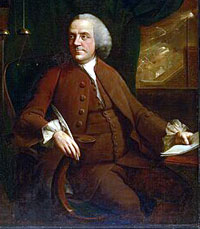
He was 17 when he arrived in Philadelphia. He took a few jobs working for local printers. In 1727, he formed the “Junto,” an organization of young professionals to discuss ideas. The organization helped form Philadelphia’s first library by 1731.
In 1728, Franklin set up his own print shop and began publishing The Pennsylvania Gazette, a newspaper which quickly became popular through Franklin’s own witty observations. Franklin had a keen sense for opportunity and developed partnerships to start other newspapers. Within 20 or so years, Franklin was part owner of nearly half the English-language newspapers in the colonies. In 1732, he began publishing Poor Richard’s Almanac, which he wrote under a series of pen names. It sold thousands of copies each year, and its success gave Franklin financial security.
He had a strong sense of civic duty, often using his imagination and creativity to benefit Philadelphia. In 1736, he created one of the first volunteer fire departments in the colonies. Officials named him postmaster of Philadelphia in 1737. Soon after, Franklin founded the American Philosophical Society in 1743 to promote science and education, becoming the first scholarly organization in the colonies. Working with a group of prominent Philadelphians, he co-founded the College of Philadelphia in 1749, which would later become the University of Pennsylvania. By 1748, he was elected to the Philadelphia city council. This was followed by a brief turn as a justice of the peace and then to the Pennsylvania legislature by 1751. While in the legislature, he quickly pushed for a charter to establish the first hospital in Pennsylvania, Pennsylvania Hospital, which was only the second hospital in North America.
Franklin’s scientific achievements were widely respected. He became one of the foremost experts on electricity in the world. In 1749, Franklin developed the lightning rod, a simple device that saved countless lives and property from the destructive force of lightning. Instead of patenting it, he made the design free to the public. In 1752, he conducted his famous experiment with a kite and key during a storm and was able to prove that lightning was electricity. He would go on to develop bifocals and the Franklin stove among other inventions. Because of his achievements, he was inducted into the Royal Society of Arts in 1756.
As early as 1754, Franklin supported the Thirteen Colonies acting more in unison. This would become even more important with the French and Indian War. By 1757, the colonies hired Franklin to act as a lobbyist in London to speak to Parliament for American interests. He noted that with the rising economic development of the colonies that one day the economic center of the British Empire would be in America. After the war, Britain’s increasingly heavy-handed tactics toward the colonies brought Franklin into a far more visible position in defending the colonies and becoming one of the leaders calling for independence.