The warm, dry winter and now a couple days of freezing temperatures has brought some potentially devastating situations to our North Texas area crops.
Sunday night we benefited from the wind (yielding no frost, for the most part), but last night the wind settled and this morning we had widespread spotty frost across the region.
At 11:00 p.m. Monday night it was 28° F in Greenville, and it was 26° F in Paris at 7:00 a.m. with the corn, soybean, and wheat crops in danger of cold injury.
Low temperatures were below freezing in Durant, OK (per the OK Mesonet Station) for 14 hours in the last two days, with a low temperature of 26F. We likely stayed below freezing for a total of >10 hours over the last two nights. Low lying areas in Grayson County may have reached 26-28F temperatures, but most areas were at 30F or above for the biggest part of the freeze events.
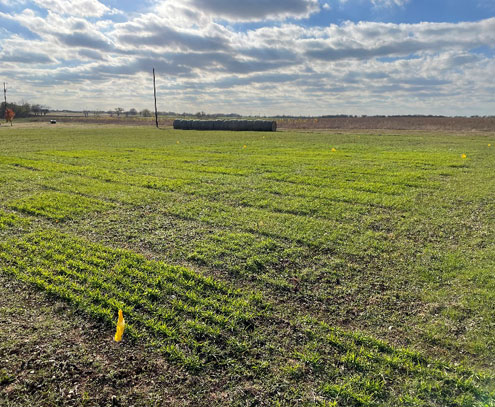
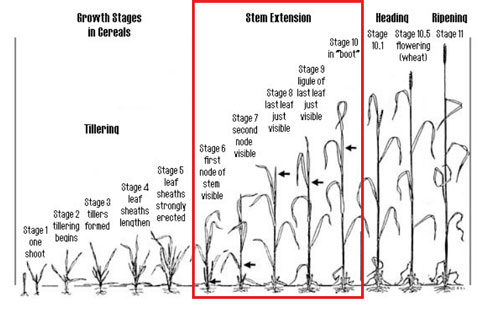
We also have many wheat fields near heading stage (past jointing in most fields; See Figure 1), and corn has been planted across the county with many fields emerging in the 1-3 leaf stage. Summer lawn and pasture grasses (bermudagrass, St. Augustine, and some native grasses) emerged and are growing slowly.
Figure 1. Most of our winter crops are in the red area of development currently (3/17/2026).
In addition to field crops, many Grayson County citizens took the chance over the last two weeks to plant gardens as well. Damage will vary by the actual temperature and how long it lasts. Severity also varies by wind, cloud cover, topography, and other variables such as soil residue, plant water status, and variety.
All this to say we had plenty of tender, susceptible foliage out there which may be stunted or set back by the two nights of freezing temperatures.
Impacts on all the vegetation will be evaluated for damage in the next two weeks, and in the head development stages in the wheat/oats crops.
Dr. David Drake, IPM Specialist with Texas A&M AgriLife Extension Service, provided some timely information regarding the freeze event the last two mornings here in Texoma:
Wheat: Most of our wheat is approaching boot stage with 28° F being the threshold for damage. Heads can be sterilized and damaged severely affecting yield. Damaged heads will become stuck in the leaf sheath or emerge deformed or bleached. I have seen several varieties that are maturing ahead of normal due to the warm winter. Assessment of losses across a field will be more difficult due to the dry conditions at planting and uneven stands.
See more info on wheat freeze on the https://varietytesting.tamu.edu/ website.
Corn: The early-planted corn is 2 -3 leaf with the growing point still below the ground and protected. The emerged leaves might be frosted and look bad but to evaluate wait several days then dissect the plant to confirm growing point health.
Below is a link on corn and sorghum cold injury from a previous row crops newsletter by Dr. Schnell
https://agrilife.org/texasrowcrops/2021/03/01/freeze-injury-low-temperature-stress-and-chill-injury-in-corn-and-sorghum/
Soybeans: Soybean are vulnerable at temperatures below 30° F for several hours. They differ from grasses/corn in that the growing point is above ground and not protected. It can however regrow from any undamaged node, although the plant may be deformed. It will be important to wait 5 or so days to assess damage. Below is a fact sheet from The Ohio State University with helpful pictures.
https://agcrops.osu.edu/newsletter/corn-newsletter/impact-frost-soybean-and-corn-survival
Garden Crops: Sensitive vegetables and herbs, particularly summer crops (sweet corn, cucurbits, tomatoes, peppers), could be severely impacted by freezing temperatures if they were not covered prior to the freeze. Cool season vegetables and herbs (mustards, chard, onions) are more tolerant to freezing temperatures than the warm summer crops and might only suffer cosmetic damage or minor leaf death. On many cool season vegetables and herbs, growing points at the center of the rosettes will survive and regrow. Sensitive plant tissue will turn yellow, purple, dull gray, and ultimately brown/black if dead.
https://agrilifeextension.tamu.edu/asset-external/protecting-landscapes-and-horticultural-crops-from-frosts-and-freezes/
For questions or additional information, please contact Chad Cummings at 903-813-4202 or email at chad.cummings@ag.tamu.edu.