

They say it was a hot afternoon in Bonham back on
Neither could have guessed they were looking at one of the most influential musicians of the 20th century.
Although it was overlooked for decades, the story of Charlie Christian is as compelling as that of legendary
Tell Willie Nelson that some of his lead guitar work is reminiscent of Charlie Christian and he will tell you that is as nice a compliment as anyone could ever give a guitar man. Everyone from Benny Goodman to Stevie Ray Vaughan and Jimi Hendrix understood the doors Charlie Christian opened, but the first door he opened was probably on
That original house at 511 Johnson is still standing and a movement to renovate the structure and create a
Another supporter is local businessman Wayne Moore. Add Fannin County Attorney Myles Porter, Carole Stanton, Director of the Sam Rayburn House and
Here are some of the emails received at North Texas e-News:
A world without electric guitars would be unthinkable today. It still is a dream for millions of teenagers around the world and it has been the common companion to countless stars, from Chuck Berry to Carlos Santana to Jimi Hendrix to Wes Montgomery to B. B. King to… But it was not always like this. The guitar used to be mainly a Spanish instrument, if only for our long tradition and the sheer number of composers and virtuosi both in the classical and flamenco fields, like Segovia and De Lucía.
The reason why a totally different kind of guitar, an electric version of the instrument, has become a staple of popular culture is because an early model happened to fall in the right hands, those of Charles Christian of Bonham, Texas. Not only he was amazing at playing jazz with an electric guitar, but he also started a long-standing tradition of Texan guitar slingers, helped opening doors from African-Americans, and changed the course of music, and all this in just two years within Benny Goodman’s ranks. His recordings are a demonstration of the joy of music. It is just fitting that the humble home that saw his birth is restored to become a museum to honour his memory and celebrate his legacy.
Fernando Ortiz de Urbina
Translator and correspondent in
Although a number of performers had used electric guitar before, Christian was the first to improvise in a way that a saxophone or trumpet player would. His sound was rich and full; his improvised melodies were sophisticated both in terms of phrasing and choice of notes; his sense of time was propulsive and swinging; and his lines were fresh yet clearly rooted in the jazz tradition.
Although best known perhaps for his stunning Swing solos with the Benny Goodman big band and small groups, he also contributed significantly to the emergence of what became known as Bebop. Always an enthusiastic participant in jam sessions, he was a regular at Minton’s in Harlem where Thelonious Monk and other seminal contributors to the new style were working out what was to become a major watershed in modern jazz. Christian’s sense of phrase and line was recognized by these musicians as a major factor in how the new music evolved.
For someone who recorded for only a short time and who died tragically so young, his lasting influence on guitarists and jazz musicians in general are a testament to his creative genius.
Howard Spring
School of Fine Art and Music
University of Guelph
Guelph Ontario
Canada
I thank God that I was born into a family of musicians. My parents took me to many concerts by touring jazz groups, one of which was a Jazz at the Philharmonic tour where I first heard Barney Kessel. That triggered my interest in jazz guitar. Years later in the late 1950's while looking through the jazz section of a local record store I saw the interesting looking lp album titled "Charlie Christian with the Benny Goodman Sextet and Orchestra" (Columbia CL-652). At the time I'd never heard of Charlie Christian but upon listening to it briefly I immediately purchased it. After taking it home I think that I must have listened to it repeatedly for days on end. I later found out that he was a fellow Texan, born in Bonham, whose life overlapped mine by a few years. I was starting to play with local jazz combos at the time and I later bought a recording of Charlie Christian's famous Minton sessions. Those two record albums came to be my all-time most important music teachers. Charlie Christian's style and originality on guitar became my idea of the defining way that a jazz guitar should be played. Without trying to copy his licks, I was strongly influenced just by listening and yielding to the spirit of his style. When jamming with others I got several unsolicited comments about my Charlie Christian sound. Those comments are some of the greatest compliments that I have ever received. To this day I feel that no other jazz guitarist has had a greater or longer-lasting influence on music or on me than Charlie Christian.
Now that I hear that the city of Bonham is working to preserve his birthplace home, I feel that it will be a great step toward keeping his legacy alive for future generations. Musicians and Texans should be very grateful for that effort.
Frank Garza
Austin, Texas
CC's importance cannot be overestimated. When talking about favorite musicians, he is among the first names mentioned my BB King, Eric Clapton, Wes Montgomery, and countless other guitarists in all walks of the music life. He was an inspiration to Charlie Parker and Dizzy Gillespie. Virtually all of his recorded legacy remains in print and it sells worldwide. His music swings, it's brilliant and it still sounds fresh. His home would be a popular museum and would bring devoted and respectful visitors from far and wide.
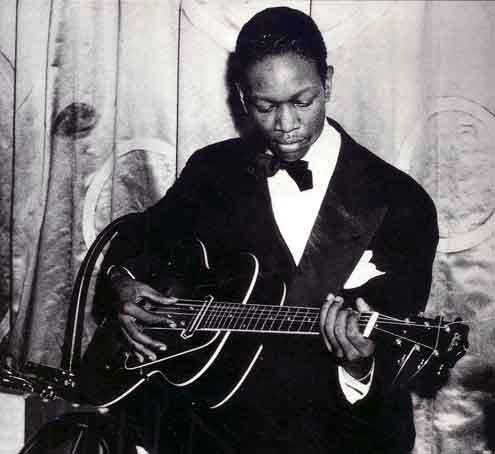
With permission from Sony Music, here are a few expert opinions about how Charlie Christian left a permanent impression on some of the best in the business.
"Charlie Christian had a depth of feeling that in my estimation nobody past or present has ever achieved. Besides being harmonically advanced for his era, the rhythmic time with which he played his notes set him apart from all others no matter what instrument they played."
—Herb Ellis, a native of Farmersville, Texas, from the liner notes for his album Thank You, Charlie Christian (Verve, 1960)
"Charlie Christian managed to change the sound of jazz guitar in the three short years he played with the Benny Goodman Sextet."
"Charlie Christian was the Jimi Hendrix of his generation."
—Warren Haynes (The Allman Brothers Band, Gov't Mule)
"The history of the electric guitar as an important jazz voice certainly begins with Charlie Christian. Fundamentally a swing player, he is nevertheless often considered a proto-bopper of sorts. Indeed, many of the most admirable elements of bop musicality — the soaring excursions beyond the confines of the familiar, the joyous sense of real-time discovery and delight, and that wonderful combination of "freshness" and "rightness" that distinguishes the playing of the great early boppers — are present in abundance in his work. The originality of his conception, the hard-driving swinging qualities of his sinuous lines, and the perfect marriage of tone and content in his playing are, in my opinion, unmatched to this day. Charlie Christian is deservedly considered the most influential electric jazz guitarist of his or any time, and listening to his recordings is always a blast."
—Walter Becker (Steely Dan)
"I had the fortune to work with Charlie Christian and he was more aggressive, forceful and louder than I was. I said to him: "You play loud"—not as a criticism or anything. He said: 'I like to hear myself!'"
—Barney Kessel, Muskogee, Oklahoma native
(Guitar Player, October 1970)
"It all starts with him: Charlie Christian is The Father. In his all-too-brief time, Charlie changed the world of jazz, blues, and everything else besides. It is literally impossible to overstate the importance of his contribution to the development of jazz. His limitless stream of melodic ideas; the many blue shades of his pungently sad, sweet tone; and his irrepressible swing all continue to influence generations of guitarists. From Wes Montgomery to James Blood Ulmer, from Tal Farlow to Charlie Hunter: It all began with the first master of the electric guitar, Mr. Charlie Christian."
—Vernon Reid
"Every guitar player, young and old, needs to go back and listen to Charlie Christian. The man single-handedly invented bebop, which is the backbone of modern music. His jazz chord stylings and guitar solos were the forerunners of today's modern jazz. "
—Brian Setzer
"That cat tore everybody's head up."
—Wes Montgomery (from Guitar Player, 1973)
"Without Charlie Christian, jazz and blues wouldn't sound the way they do today or be nearly as popular. Everybody might still be playing a banjo!"
—Jimmie Vaughan

For more information about Charlie Christian's music, visit this Website