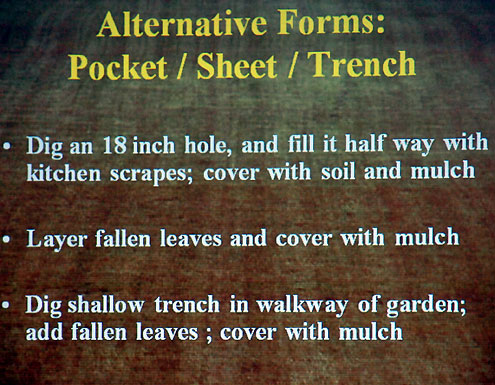
Bonham -- Local gardeners took a break from the sweltering summer heat Saturday and instead took a seat in the cool comfort of the Northside Church of Christ Activity Center to learn the dos and don'ts of composting from Collin County Master Gardener Dr. Fred Karr.
A simple composting bin can turn food scraps, newspapers, grass clippings and leaves---things that normally burden landfills---into a very rich soil that nurtures plants. A typical family can reduce their home waste stream by approximately 35% by composting yard waste and kitchen waste.
But that is only the beginning.
As Dr. Karr explained, aerobic decomposition can turn a lot of common kitchen and yard waste into porous humus that will absorb water more readily than hard, compact soils with high clay content. On typical
"All of that stuff runs into our rivers and creeks without going through a treatment plant," Dr. Karr told the attentive crowd. "Plus, it is a loss of a valuable resource."

Composting is not a new fad by any means. At least as far back as the Romans, literature tells how this process works and why it is logical to turn common waste products into a desirable product. Mother Nature was the first to put this practice to good use. Step into any forest, Dr. Karr said, and study the top layer of soil. A loose layer of damp, decomposing leaves, branches and bark is being recycled into compost to feed the forest. Take a deep breath and often you can even smell this process at work.
The purpose of Dr. Karr's presentation was to show
"All we are doing is duplicating nature," Dr. Karr said with a shrug.

If he makes it sound simple, it's because composting really is.
All you need is a piece of chicken wire rolled into a circle with a three-foot diameter. A handyman can turn out the deluxe model, which is comprised of a 3'x3'x3' wire-covered frame with a hinged top or you can buy a wide variety of compost bins.
Start with a four-inch to six-inch layer of brown matter---organic material like old leaves saved from the previous year, strips of newspaper and other dry matter that would readily burn. Since it is important that this layer of dry matter be thoroughly dampened, Dr. Karr suggests dousing it in a wheelbarrow filled with a few inches of water.
Next, add a four-inch to six-inch layer of green matter---fresh lawn clippings, fruit and vegetable waste from the kitchen.
Continue alternating the layers, dampening the brown matter each time. Top off the compost pile with a brown layer. After all, if you put a green layer on top, all the nitrogen will rapidly leach out and just leave you with another brown layer anyway.
Just think of it like a layered garden cake. And this recipe is guaranteed to put a smile on your flowers, vegetables, lawn and trees as soon as their roots get a taste of compost.
Turn the compost pile every five to seven days. In the
Don't use...
Dr. Karr said to avoid using dairy products, oils or products with animal fat, glossy paper, dog and cat feces---all will either impede the decomposition or attract the wrong kind of critters. And, really, why put anything into the bin that you don't want to be digging through every five to seven days when you turn and water your compost pile.
A healthy compost pile is a magnet for worms and a wide variety of micro organisms.
"If you build it, they will come," Dr. Karr remarked, using the well-known phrase from Field of Dreams.
The compost demonstration was made possible by a grant from the Texas Commission on Environmental Quality through the Texoma Council of Governments.

Free compost bins were even given away to 28 of the 38 attendees who came from Grand Prairie, McKinney, Arlington, Princeton, Blue Ridge, Whitewright, Tyler, Telephone, Durant, as well as Bonham.