

Dry, hot weather is placing stress on all dryland cotton and some of the irrigated cotton. says Dr.J.C.Banks, Oklahoma State University Extension state cotton specialist.
"The stressed cotton is at the cutout stage in many areas, and yield potential will be further limited if rainfall is not received soon," Banks said. "Cutout is defined as when the plant slows vegetative growth and transfers most of its energy into boll development. It is officially determined when the top of the plant is within four to five nodes of the uppermost first position white bloom, but it can also be easily determined when we start observing blooms in the top of the plant.
"Producers refer to ths as 'blooming in the top.' In healthy plants, the nodes above white flower should be seven or eight at first bloom, and decrease by approxmately one node per week during blooming. We have not only been observing this in dryland cotton, but also in irrigated cotton when water is short or root growth has been inhibited. In some fields, we are observing what an extension specialist in Louisiana refers to as suspended cutout. The nodes above white flower stay the same and the plant continues to fruit for several weeks.
"If these fields are irrigated, irrigation scheduling may need to be evaluated. If the fields are getting plenty of water, the next thing to look for is a nitrogen or other nutrient deficiency caused by a restricted root system. In these situations, a foliar nitrogen application could extend fruiting allowing the plant to hold onto one or two more bolls.
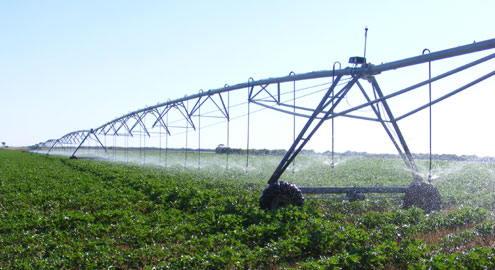
Irrigation from wells is often accomplished with center pivot systems. Moving constantly in a circle, the overhead pipe delivering the water, powered by an electric motor, releases the water in an overhead spray. To offsett moisture evaporation, the water is sprayed from lowered spray heads to keep the water closer to the crop. This is a quarter section of no-till cotton, double cropped behind wheat, located a short distance west of Snyder, Ok., on the south side of HW62. The cotton is farmed by Bates Brothers, Altus, Ok. photo courtesy of NTOK Cotton
"For dryland fields, about all we can do is 'hunker down' and wait for rain. A rainfall soon will cause some drop of small bolls that already were going to shed, but new growth will initiate and new squares and bloom will develop in the top of the plant. These new squares need to be on the plant by mid-August to produce a harvestable boll."
SURVEY PARTICIPATION by US cotton producers for a 20 minute, anonymous online Natural Resource Survey is very important to the success of the Cotton Research and Promotion Program that Cotton Incorporated conducts on producers' behalf.
Questions about the survey, which is being extended to garner additional responses, can be found at agsurvey@cottoninc.com.
Specifically, the survey willl hep identify the great strides producers have made in production efficiency and natural resource management. These are findings that can be used to develop US cotton's environmental message to global textile industry, brands, retailers and consumers.
Producers are asked to complete the questionnaire only once and only if they have production responsibility for a cotton farming operation. Following completion of the questionnaire, producers also may requrest a "Cotton Natural" t-shirt in sppreciation for their effort.
TALKIN' COTTON is produced by NTOK Cotton, a cotton industry partnership which supports and encourages cotton production in North Texas, Oklahoma and Kansas. For more information on the cotton scene, see www.okiecotton.org and www.ntokcotton.org.
For questions and comments on Talkin' Cotton, contact eventerprise1@hughes.net.