

But lighten up; your fishing rod may be one the best management tools available, said Dr. Billy Higginbotham, Extension fisheries and wildlife specialist.
"While it's true that the pasture may need mowing and the barn may need painting, you just have to make time to go fishing to determine the health of your farm pond fish populations," Higginbotham said.
This "angler management" strategy is true for the estimated 1 million farm ponds – small and large – that dot the Texas landscape, he said. At the least, regular fishing will tell the pond owner what fish species are present.
"While all species are not vulnerable to hook and line, many are, and their presence or absence can help you formulate sound management decisions," he said. "For example, a trotline baited with cut bait will provide an indication of which catfish species may be present in small ponds."
Bullheads on the trotline instead of channel or blue catfish may signal the pond owner that it's time to renovate and restock the pond.
Do largemouth bass show up on the hook? "Great," Higginbotham said, as long as the surface area of the pond is one acre or larger and water quality allows 15 to 18 inches of visibility. Smaller ponds do not support largemouth bass in "a sustained manner," however, because of the species' need for an abundant supply of forage fish.
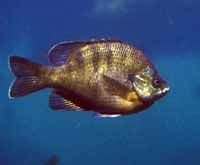
"Pond owners interested in producing quality bass fishing will want to grab a cane pole and can of worms and verify the presence of bluegill as the base of their forage population," Higginbotham said. "Other forage species serve to supplement the bluegill, but none can replace it in terms of its adaptability and fecundity in our Texas ponds."
Bluegills can be distinguished by four characteristics: a small mouth, black or blue ear flap, vertical bars on its sides and a black 'ink blotch' at the rear of its dorsal (top) fin, he said.
"In addition to simply verifying the bluegill's presence in a bass pond, you also want to gain a sense of the size distribution of the species," Higginbotham said. "Using a No. 8 hook, keep fishing until 100 bluegills are caught. It's a great activity for the kids."
Lay each bluegill flat and measure from the tip of closed mouth to the tip of the tail. Record the length along with the date.
A cane pole may work for bluegill, but to take a census of largemouth bass, a rod and reel is needed. Higginbotham recommends fishing with three distinct sizes of lures (No. 1-2, No. 2-4 and No. 4-8).
"The reason is simple – if you don't fish with all sizes of baits, you won't obtain a representative sample of all bass that are present in the pond," he said. "Fish each lure category for 30 minutes before switching, and fish each size lure the same amount of time while fishing – uh, sampling – all areas of the pond. Catch at least 20 bass over 8 inches in long in order to have a valid sample for analyses and record total lengths for each bass caught."
The final evaluation doesn't require a fishing pole, but that doesn't mean you can't keep fishing while you make a few simple calculations with pencil and paper, he said.
For largemouth bass, anywhere from 40 percent to 70 percent of the fish caught should be 12 inches long or longer. About 20 percent to 25 percent of the bass catch should be at least 15 inches long.
That's if your goal is to produce larger, trophy size bass, Higginbotham said.
As for bluegill, from 50 percent to 80 percent should be at least 6 inches long.
There are other factors to take notice of. Too many "skinny fish" in any category may indicated water quality problems, lack of forage fish or too many weeds limiting the ability of bass to catch the forage fish.
More information on pond management can be found on the Internet at http://pond.tamu.edu/ .