Printed From North Texas e-News == ntxe-news.com

Front Page
Travel Quest: Canada's City of Champions is more than just blustery winter days
By Jim Soliski
May 15, 2005

What Canadian city has the second largest Fringe Festival in the world, more parkland per square mile of urban sprawl than any other in North America, the world's largest shopping mall, the fastest growing economy in the country, The World Track and Field Championships this past summer, the second busiest Tony Roma's, only after Disneyland's, and is the service and jumping off point to a lake of crude oil many times greater than Saudi Arabia's?
 
It's a place called Edmonton.
 
Fur traders supplying The Hudson Bay Company arrived in the early nineteenth century to find the resident Indians disinclined to share their bounty. The North West Mounted Police, now the Royal Canadian Mounted Police (RCMP), built a fort on a curve of the North Saskatchewan River. As a favor to a clerk, the police force named the new settlement Edmonton, after the grungy East London community of the same name.
 
The federal government was anxious to settle the west. After a long public relations campaign in the United Kingdom, the well of fresh immigrants willing to pioneer a wide-open land dried up. Clifford Sifton, the Minister of the Interior, reached across Europe to the east, and found a fountain of talent perfect for a land with a reputation of hard winters. Slavs, such as Poles, Ukrainians, Hungarians and so on were tired of Russian domination, and easily settled into Western Canada. The New World resembled their roots - long winters, expansive prairie, loads of forest and pastureland. Best of all, no one was trying to kill them.
 
The population of Edmonton in 1892 was 700 hardy folks. It boomed during the Klondike gold rush near the turn of the century, and then grew to 9,000 by 1904; the year that Edmonton was incorporated as a city. When the Province of Alberta was founded in 1905 Edmonton was, by then, Alberta's largest community. Edmonton's size and central location made it the obvious selection to become the provincial capital.
 
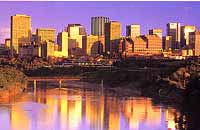
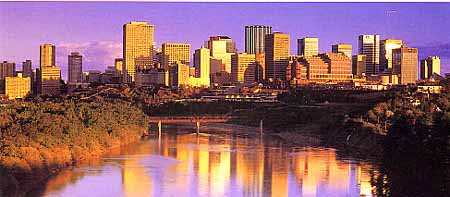
In 1912, Edmonton on the north side of the river, and the town of Strathcona on the south, amalgamated into a combined population of over 53,000. The High Level Bridge was completed in 1913, linking the two sides and creating one of the city's better-known landmarks. The trading area of present-day Edmonton totals nearly a million.
 
From the Eastern European influence, Edmonton has earned the ignoble sobriquets Garlic City or Edmonchuk. It's also known as The City of Champions because of the past success of the Edmonton Eskimos football team and the Oilers hockey team of the NHL. You'll also hear Festival City because of a plethora of year round festivals and theater or River City because of the beautiful river valley and its developments. Edmonton is the capital of the most right wing government in Canada, and has a reputation of hard living, hard working, hard talking oil patch workers, truckloads of snoose-spittin' farmers, and a vocal opponent of federal gun registration laws. This image is in contrast to the sight of these same boors rubbing shoulders at the opera or sponsoring local art shows and neighborhood theater.
 
Even Edmonton's weather gets a bum rap. Because of Edmonton's geographical positioning, tucked in 200 miles behind the Rocky Mountains, moisture from prevailing warm winds from the Pacific Ocean gets wrung out over the mountains, leaving the humidity low and ever so pleasurable during the summer. The lack of moisture means Edmonton is generally spared the slush and ice of Eastern Canada. Everything comes with a price, so the dry air permits the temperatures to drop during winter. Two or three sessions per winter of 25 below comes with the territory. Clear and cold is the common forecast. Folks from coastal areas, especially the United Kingdom continually comment, "Even though it's cold, the sun shines and I'll make that trade." But anyone who's lived a winter or two soon comes to understand that Edmonton is undeserving of a reputation as a polar tundra outpost.
 
West Edmonton Mall is the largest shopping center in the world, built over three phases beginning in 1979. The same developers constructed the Mall of America in Bloomington, Minnesota, which overtook the crown for a few years. A recent addition of stores, movie theaters, a digital technology playground, and casino expansion pushed WEM back to the top. Millions of tourists travel to this, in effect, enclosed city each year to shop, ice skate, swim, eat, ride in submarines, watch dolphin shows, gamble, nightclub, and spend their money. Retailers enjoy a Christmas rush, of course, plus smile just as wide during July and August for the tourist season.
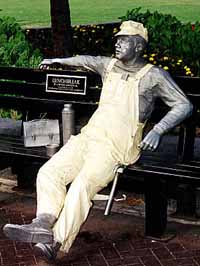
 
Whyte Avenue, the main street of defunct Strathcona, is now the trendy, Bohemian Greenwich Village of town. The Fringe Festival takes place in Old Strathcona for ten days in August, knitting its experimental and street theater with the coffee houses, nightclubs, eclectic shops, and street scenes. December is the time for the Ice on Whyte Festival, (http://www.osba.ab.ca/) where 30 artists shape 100 blocks of ice into figurines. Not everyone is a fan of the neighborhood. Its growth has been criticized by the accumulation of late night drinking establishments (some claim a glut). Opponents assert booze subtracts from the tranquil, arty feel. A recent closing time riot fuelled by testosterone, alcohol, and questionable police strategies has galvanized anger coupled with cries of, "We've been telling you so!" by the residents. Late night noise during the summer has the populace on its own warpath, with no immediate resolution pending.
 
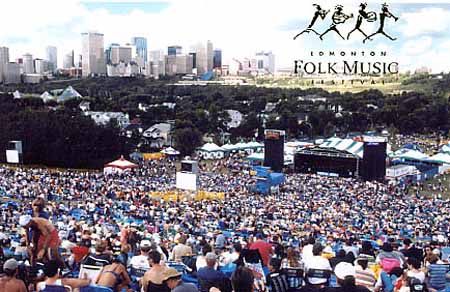
Besides The Fringe, the annual city extravaganza is dubbed Klondike Days, ten days in July of period costumes, hair plumage, and lace stockings for the ladies, and top hats, arm bands, and walking canes for the men. The International Street Performer's Festival and The Folk Festival have gained reputations among players as One Of The Ones to Attend If I Can Get Invited. The long weekend in August hosts Heritage Days, a party of multiculturalism that draws 350,000.
Edmonton is not nearly as busy as during the warm months. Labor Day sits as an unofficial deadline signifying the close of summer. Activities generally begin to move indoors. The Edmonton Symphony Orchestra, The Alberta Ballet, The Citadel Theater, and Winspear Concert Hall all start in on their new seasons. The John Janzen Nature Center (780 496 2939) celebrates fall with a new activity each week, and the Celebration of Nations Festival ( www.geocities.com/cofnsociety) takes place the last week of September.
Gardeners gather their vegetables and farmers work long hours. Many of the nouveau riche take time off work to help out. Training camp opens for the NHL Oilers, which always sets the city on a buzz. Each year is filled with promise, although Edmontonians have almost moved on from the days of Gretzky, Messier, and Lowe. The most successful franchise of the Canadian Football League, the Eskimos, haven't missed the playoffs since 1972, and their yearly fate hangs heavily in the balance once the leaves begin to change color.

Candy Cane Lane is one of the city's most anticipated Christmas events. What started out as a few neighbors decorating their yards has turned into an annual event that employs virtually miles of cord and bushels of bulbs to light up approximately fifteen blocks of residential houses.
 
Massive, and we're talking massive, oil and gas deposits in Northern Alberta, headed by the oil sands of Fort MacMurray five hours north, plus successful provincial government after years of greed and nest-feathering, has turned Edmonton into the fastest growing city in Canada. Calgary, three hours south, toggles with Edmonton for the crown. Calgary has the corporate offices and management, and Edmonton the technical expertise and supply base. There's nothing like solid prices of crude and natural gas to keep the economy humming, and continue to put Ralph Klein's Progressive Conservatives in the seats of the legislature. Recent poorly planned deregulation of power put the premier in a hotter seat than he would like, but a fall election installed him with another huge mandate.
 
Edmonton's greatest strength is for those raising a family - it's not a place to go blow off steam. Housing costs rank around twelfth in Canada, similar to Montreal without the prohibitive taxes. There are tons of accessible, affordable, modern facilities: skating rinks, swimming pools, wide-open spaces, and traffic that neither chokes your nostrils or time. The streets are clean and wide. Facilities left over from the 1978 Commonwealth Games and 1982 Universiade put Edmonton a leg up on most cities for winning athletic events.
 
Younger singles find a lack of places to get into their own brands of excitement. Conservative puritans still retain a toehold on the politicians, evident in a recent bylaw banning rave dancing after 3 a.m. Nevertheless, Edmonton's strong job market, vibrant arts scene, and a small-town decency amid its rapid coming of age keeps skeptics around, or at least coming back after a trip to the not-so-greener other side of the fence.

 
If You Go...
 
An international airport services Edmonton 25 miles from city center. A cab to downtown or West Edmonton Mall costs $30 to $35. Weather in the summer averages 75 for a high to 50 at night. Because of Edmonton's northern latitude, the sun sets ever so slowly, grudgingly tucking away around 11, then popping up again at 5. Winter is a different story. The Rocky Mountains resort towns of Banff and Jasper are four hours by vehicle, or take the train for a spectacular ride. Calgary is three hours south down the four-laned Highway 2.
 
For websites, go to http://www.gov.edmonton.ab.ca/ or http://www.discoveredmonton.com/

For West Edmonton Mall, go to http://www.westedmall.com/

For The Fringe Festival, go to http://www.fringe.alberta.com/

For the Folk Festival, go to http://www.edmontonfolkfest.org/

For Klondike Days, go to http://www.klondikedays.com/ 

For a comprehensive list, go to http://www.festivalcity.ca/

For Jasper, go to www.worldweb.com/parkscanada-jasper

For Banff, go to www.worldweb.com/parkscanada-banff

© Copyright 2002-2005 by North Texas e-News, llc.