

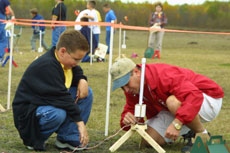
Mr. Mahler helps a Howe fourth grade student get his ignitor ready before launch time.
For 10 years now the Howe fourth grade class has had an opportunity to get a little closer to space. Once a week for seven weeks students met after school to learn how to build a rocket.
“For our hobby to grow and prosper, young people need to be introduced to joy of rocketry,” is how Ted Mahler sums it all up. With rocketry you get to witness first hand the joy these kids have of building something from scratch then making it fly hundreds of feet in the air. Then if they're lucky you can take that same rocket and do it all over again.
One of the best ways to do this is to incorporate rocketry in schools. For 10 years, Ted has been a volunteer teacher for a fourth grade, school sponsored, rocket class. “One of my goals with this class was to leave each child with not only the knowledge to continue the hobby, but all the equipment needed as well, including a launch pad and controller,” Mr. Mahler stated. When Ted was setting up the course he discovered there were few information sources for plans of individual ground support equipment. For this launch equipment he was seeking the following characteristics:
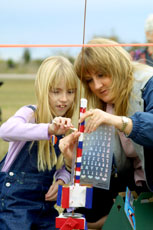
It's gotta look good and fly good.
2.Would require assembly. Nothing teaches better that hands-on experience. I wanted to present some basic electrical theory and having the students actually build the launch controller would reinforce the theory.
3.Assembly must be easy for a fourth grader in a classroom environment where each child may not receive individual attention.
4.Equipment should be rugged. These are fourth graders, need I say more?
5.Equipment must be able to be easily produced, in my garage, for 50 students.
To tackle the cost problem, I soon learned that the use of prefabricated parts like pushbuttons quickly ate up the money. Yet not using prefabricated parts increased the time it took me to make the parts. So a compromise had to be reached.
Launch pads are constructed from inexpensive, easy to find 2x 4’s and 1x2’s that total about $1.05 each. The launch controller is made up of a wooden base and inexpensive electrical parts that come to $2.85.

This year was Ted's 10th year to teach the rocket class.
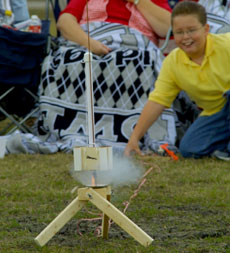
It's all about the smiles
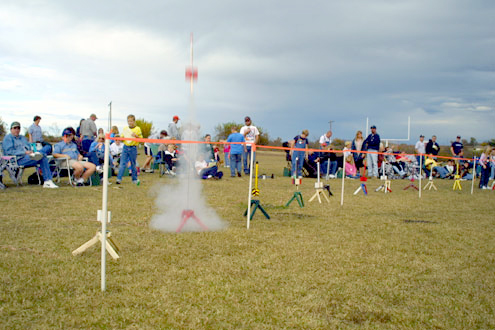
The rockets were lined up and ready to launch according to a prewritten launch schedule.
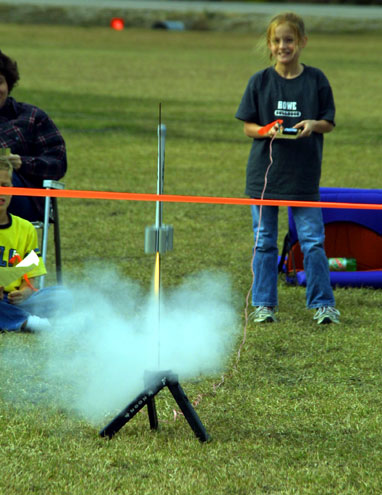
Future NASA engineer??
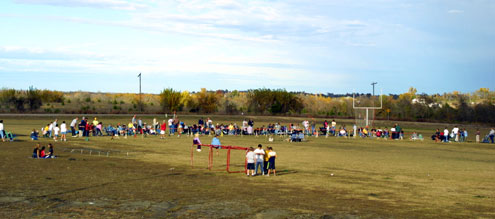
Crowds were present to watch the flight of the homemade rockets.