|
|
Luke Clayton
|
One common trait that all successful fishermen I know have in common is their ability to read and interrupt the sometimes subtle signs of Mother Nature. I recently got off the water with a couple of Lake Tawakoni (located one hour east of Dallas) fishing guides that eagerly await an event that takes place during late summer and early fall every year: the grasshopper migration!
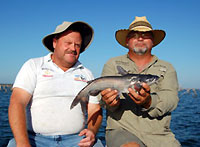
Guides George Rule and David Hanson make their living putting their clients of catfish on a year-around basis. Both are trophy hunters and during the winter months, their clients daily weights of blue catfish often tallies in the hundreds of pounds. Late summer and early fall fishing is different; it’s a time for non stop action on blues and channels weighing between 1.5 and 5 pounds, with an occasional trophy fish thrown just to keep everyone on their toes!
As we left the cove leading from Anchor Inn Marina into the open waters of Tawakoni, both guides were very confident of the fishing action we were about to encounter.
“We have been limiting our customers out in a couple hours fishing each day,” offered an exuberant Rule and he hammered down on the big engine. “You would think the catfish would be in deep water, and actually they are but we’re not fishing deep, we’re catching them three or four feet deep below a floater in water that averages 32 feet. Grasshoppers are the primary reason for this shallow water action.”
I could easily see the areas of the lake known locally as “The Woods” was our destination.
As we approached the standing timber and slowed to enter a boat lane that led back into the thick stuff, I noticed hundred of white cattle egrets perched in the dead trees. Looking back into the trees, I noticed swirls on the water’s surface.
“Must be white bass or stripers chasing shad back in there,” I said casually as we motored slowly down the boat lane.
“Look closely, Luke and you will see those are catfish rising to the surface,” said Hanson. “Study the trees as we pass by; many of them have grasshoppers hanging on for dear life. The instance they hit the water, catfish will swirl the surface and pick them off.”
The hordes of cattle egrets were obviously there to eat grasshoppers as well. The greedy bird’s droppings, just like cormorants (water turkeys), serve as a natural “chum” for the catfish. With this abundant food in the form of live grasshoppers and chum from the egrets, I could readily see why the water’s surface was dimpled by catfish rising to the occasion for an easy meal!
Hanson eased his big boat to an idle and we very cautiously motored back off the boat lane, maybe fifty yards. We tied the bow to a tree and he and Rule began breaking out the tackle.
Obviously, grasshoppers would have been the ideal bait but, as Rule kidded, “Have you ever tried catching enough hoppers to keep everyone fishing for a couple hours?”
I eyed a couple gallon buckets of Danny Kings Catfish Punch bait in the back of the boat, Garlic flavor!
“Danny King’s bait is tailor made for this type fishing,” said Rule. “It stays on the hook well and the scent it puts in the water makes a good situation even better.”
We were using #6 treble hooks set three to four feet under slip floaters.
“We should start catching fish immediately, but just wait till that smell permeates the water and some of the bait particles float to the surface. We are just about to be in the eye of the hurricane,” said Hanson.
He was not wrong! We didn’t catch any large catfish; the largest weighed around five pounds, but in my years of catfishing, I never remember such steady action. The drill was pretty basic: bait up, get the punch bait in the water and watch the floater. Seldom did it sit still more than a few seconds. Our guides say this steady action should continue through late fall then, the big fish action will begin.
TO BOOK A CATFISH TRIP AT TAWAKONI, CALL GEORGE RULE AT 214-202-6641 OR DAVID HANSON AT 800-269-7227.
Check out ACATS OUTDOOR HOUR WITH LUKE AT http://www.catfishangler.com/ and http://www.dannykings.com/ to learn more about the catfish bait.